
24 Event Pros Told Us Where Experiential Marketing Is Headed.
The Answers Were Surprisingly Human.
That’s right, like some of you, one month ago we were on the show floor at Event Marketer’s 2026 Experiential Marketing Summit.
And while our fellow TentCraft Reps were busy at our booth, myself and our visual content specialist, Rob, decided to ask the experiential marketing professionals and event teams on the show floor about the state of the industry overall.
Tl;dr - Here is what we’ll cover this month:
-
7 core trends came up across the 24 respondents
-
54% of the responses emphasized “Human-first and Interactivity”
-
21% of event professionals pointed to AI, digital saturation, or technology fatigue
-
4 Distilled Takeaways For Brands Moving Forward
Full Video In Case You Missed It 👇
The 7 Experiential Trends That Showed Up In The Responses
When we played back all 24 responses we received at the show, we immediately noticed that everyone was hitting on a few key themes.
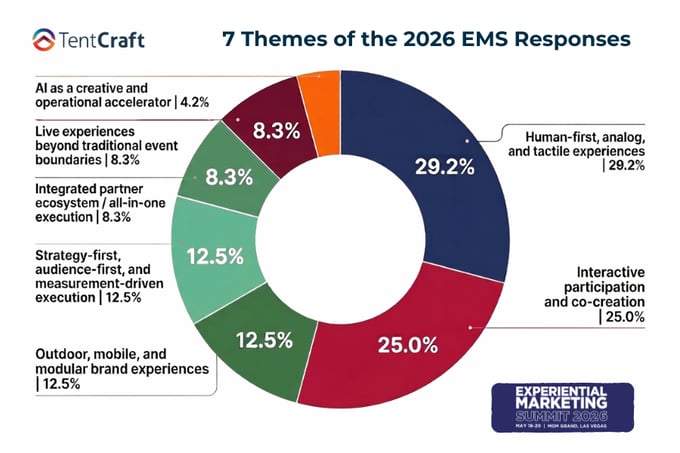
1. 29.2% of Responses Highlighted the Growing Demand For Human-first, Analog, and Tactile Experiences
Event pros from agencies, brands, and partner vendors pointed to a growing appetite for real-world experiences that feel personal, physical, and memorable.
So many people noted that attendees and brand representatives alike are increasingly growing weary of their digitally saturated worlds, the infusion of AI into everything, and devices & screens being a constant in our field of view.
Because of this, people are craving grounded, in-person moments they can touch, taste, photograph, and genuinely connect with other people through.
“Brands are looking for that touch and analog experience for their brands, that’s why they want to come in and really experience things by touching the button vs just going into screens.”
-Paulina Modestow | VDA

2. 25% of Responses Emphasized Interactive Participation and Co-creation
Almost as popular were the responses emphasizing that attendees no longer want to simply observe a brand activation or absorb your swag.
They want to participate in the experience and come away with something personal whether it’s a memory or something they made with you.
It could be playing games, physically or on digital screens, encouraging people to help re-organize and interact with parts of your booth, having a photo opportunity, or it might be inviting them in to create something with you that they can then leave with.
“You could have the biggest, boldest, shiniest booth out there, but if you don’t have an interactive element to fill it with, people aren’t going to remember it.”
-Arielle Dukofsky | Interactive Entertainment Group

3. 12.5% Referenced Outdoor, Mobile, and Modular Brand Experiences
Several event pros called out the value of flexible, outdoor, and mobile activations that can meet audiences where they already are.
This one feels like it was influenced largely by the fact that many folks at EMS, especially those who work with traditional exhibit houses have been more focused on indoor experiences. And now they’re starting to hear from brands that they want more access to their customers who are at some major outdoor events.
If we read between the lines, there was an emphasis on “mobile” and “modular”:
-
Mobile is important because the assets they use are going to be traveling from space to space and need to be convenient to transport and set up during the campaign.
-
Modular was discussed for reasons of budget efficiency and also to accommodate or adapt to multiple environments (outdoor vs indoor) and various size footprints.
Aka, event teams need the infrastructure for experiences that are easier to move, adapt, and reuse across different spaces.
“Just looking at emerging trends or where we see a big push in the industry and it’s mobile. We see a lot of brands that want to be in front of the clients where the clients are.”
-Dwayne Virag | Guerrilla Cube

4. 12.5% Recommended Approaching Experiential Campaigns With a Strategy-first, Audience-first, and Measurement-driven Design
Seasoned experiential marketing veterans stressed the importance of intentional, strategic decision making. It felt like this was in direct response to the flashy-ness that was on full display on the EMS floor, especially at booths with high tech screens and custom LEDs that can now come in every shape you can think of.
They reminded us all that great experiential marketing should start with the audience and the desired outcome because we all have a tendency to wander toward the flashiest idea or newest technology when we allow ourselves to get distracted.
So instead of immediately reaching for that custom LED-tiled sphere with a thousand preset graphics, start by asking if it’s going to get the response out of your audience that you need and it’s going to represent your brand how you want to be perceived.
“My hot take is all about the phone calls or emails I get where somebody is asking what is new and cool in technology and it is not the thing that you should be reaching out about. What you should reach out about is here's an objective that I would like to achieve. Here's my audience and here's my insight. [...] I can show you what's new and cool. I get distracted with reels but it really is about what is that end metric.”
-Mark Stewart | WonderMakr

5. 8.3% of Respondents Said There Is a Push from Brands and Agencies To Work With Integrated Partner/ Vendor Ecosystems & All-in-one Service Providers
This is really about simplifying the complexity out of event execution as much as possible.
Rather than coordinating multiple disconnected vendors, brands and agencies are looking for more streamlined support across planning, production, logistics, and on-site delivery.
At TentCraft, we’ve also seen and heard this shift over the last few years. We’ve responded similarly by now offering:
-
A curated product line beyond tents to custom truss structures, SEG, and portable trade show assets
-
Branded purchase portals for dispersed, remote brand & agency teams across regions
-
World Class Displays (we purchased ~2 years ago) to expand into truly custom booth design and show services
6. 8.3% Said That Live Experiences Are Expanding Beyond Traditional Event Boundaries
These responses capture the idea that experiential marketing is expanding beyond the standard trade show booth or scheduled event activation.
Brands are thinking more broadly about where live engagement can happen, from pop-ups and community spaces to sponsorships, tours, and unexpected guerrilla marketing takeovers.
It feels like almost anything can be a successful live experience if it activates people to do what you expected them to.
“There are no rules.There are no boundaries. Anything is an activation. What is an activation to you? Is it a coffee station? Is it balloons? Is it lighting? Is it LEDs? Is it an app that turns a static image into a wonderful landscape [...] Am I activating you right now?”
-Steve Rad | Abacus Brands

7. 21% Acknowledged the Use of AI as a Creative and Operational Accelerator but only 4% Said It Without a Caveat
AI was actually acknowledged in 21% of responses so the topic was popular amongst the people who felt like this technology was creating a shift.
However, only about 4% of event respondents mentioned AI as an operational accelerator without adding any caveats. AI, despite how it helps operators, is having its biggest impact on the experiential industry by creating less trust in digital spaces and online media channels and is therefore driving more people to turn toward in-person events and experiences.
“[...] AI. Lately, it's been super beneficial for us for creating renderings, scoping projects, and working through a lot of nuances. But I think what it's going to do to our industry is only enhance the in-person experiences. As AI keeps coming along, you can't really trust what you're seeing online anymore. So photos, videos are really starting to get murky on what actually happened. So it's only going to enhance people coming to the events and wanting to be there and experience it for themselves.”
-Steve Damman | TentCraft

What We Found Interesting:
54% of the responses emphasized “Human-first and Interactivity”
One of our favorite takeaways is that the people we spoke with were truly emphatic that you can’t remove what makes us human from what makes experiential marketing successful.
Despite there being a rapid increase in technological innovation, if you over-index on putting technology in the spotlight rather than using it in a support role to make your point more effective, you’re likely going to fail at endearing people to your brand’s experience.
It’s also important to acknowledge that “Human, analog, tactile” and “Interactive” are not separate trends. They are really two halves of one larger movement.
People want to be involved in the experience, talk to each other, compete, create, and touch.
21% of event professionals pointed to AI, digital saturation, or technology fatigue
AI and digital showed up more as a cultural force than as a category.
Only one response was categorized directly under AI, but AI influenced several human-first answers. That matters. I think all of us feel the uncertainty and the double-edge sword nature of technology at this moment.
AI, distrust in social media, working in front of screens, scrolling on phones are all creating a renewed hunger for real-life proof, presence, and participation.
4 Grounded Takeaways We’re Walking Away With in 2026
While 24 responses may not be a large sample size, who these anecdotal data points are coming from and what we can walk away with feels highly valuable.
Here’s what we’re taking with us:
-
Real Beats Generated
-
Participation Beats Presence
-
Mobile and Modular Beats Fixed
-
Strategy Beats Spectacle
Monthly Staff Picks - Reads, Watches, & Listens We Think You Might Like:
EventTrack 2026 (Event Marketer & Sparks)
5 Metrics Your CMO Actually Cares About (And How Events Can Own Them) by Jess Hopp (Vendelux)
Deciding if Trade Shows Are Still Worth It by Brennon Bynum