
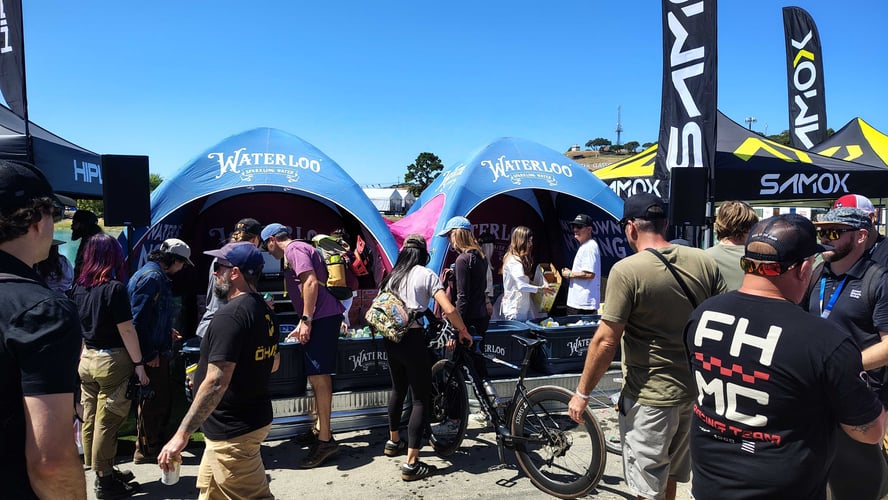
Both inflatable tents and pop-up tents give event teams a portable, branded structure they can use for outdoor activations, sampling programs, check-ins, merch setups, hospitality areas, sponsor footprints, and recurring field events.
But once you get past the basic idea of “portable branded coverage,” the differences start to matter.
A pop-up tent gives you a familiar, versatile event structure with a wide range of sizes, frame strengths, accessory options, and customization possibilities.
An inflatable tent gives you a more distinctive branded footprint with fewer rigid frame components to transport and manage, while introducing a different setup process through inflation.
So how do you know which one fits your event?
Below, we’ll compare inflatable tents and pop-up tents by setup, portability, branding, size options, customization, cost, and common use cases.
What We Mean by Pop-Up Tents
When we talk about pop-up tents in this article, we’re talking about the kind built for repeated event use, not the flimsy backyard canopy you might grab for a one-off weekend.
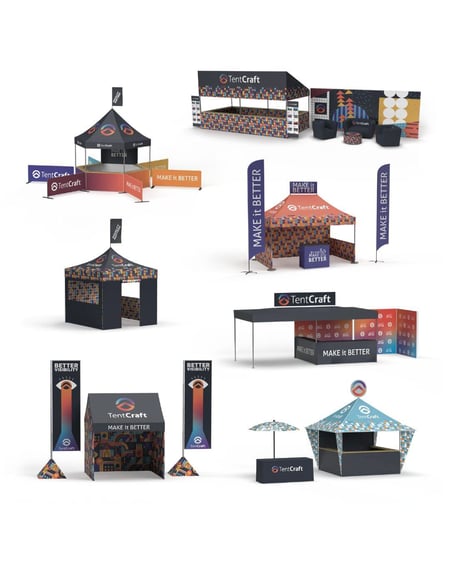
A commercial pop-up tent typically uses a collapsible scissor-style frame, telescoping legs, and a custom printed canopy top. That design is what makes it such a familiar choice for event teams: it packs down for transport, sets up without tools, and gives your brand a clear, covered footprint at the event.
You’ll see pop-up tents used for product sampling, vendor booths, check-in stations, merch setups, hospitality areas, sponsor activations, and plenty of other field marketing needs.
What We Mean by Inflatable Tents
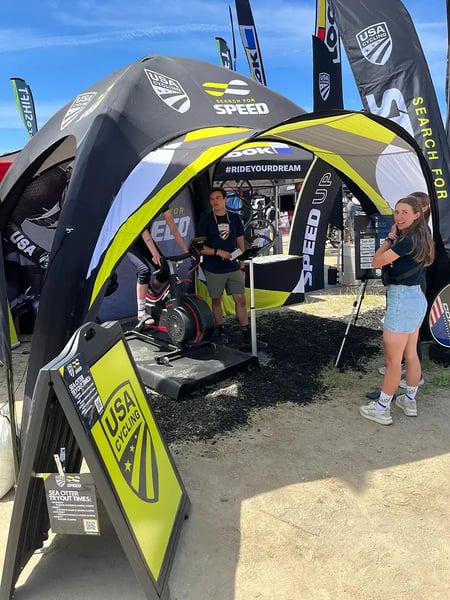
When we talk about inflatable tents, we’re talking about event structures that use air-filled beams instead of a traditional metal frame.
That changes the basic setup process. Instead of unfolding a scissor-style frame and extending telescoping legs, your team inflates the structure onsite using a pump. Once inflated, the tent creates a covered branded footprint with a different shape and presence than a standard pop-up canopy.
You’ll see inflatable tents used for many of the same kinds of events as pop-up tents, including product sampling, check-ins, sponsor activations, hospitality areas, mobile marketing programs, and recurring field events.
See It in Action: Waterloo’s Inflatable Tent Setup
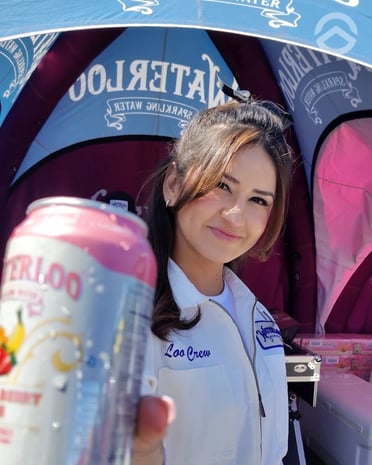
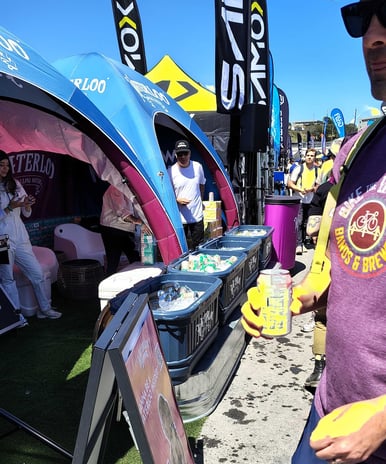
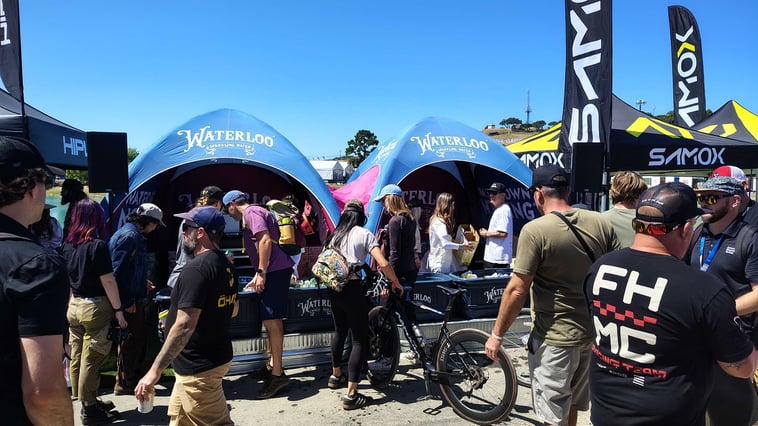
Waterloo Sparkling Water used a connected pair of custom 10x10 GYBE inflatable tents to create a grab-and-go sampling experience that felt polished, approachable, and easy for people to move through.
That use case is a good example of where an inflatable tent can make sense. Waterloo needed a branded footprint that could support product sampling while standing out on a crowded event site. The curved inflatable structure gave the setup a more distinctive silhouette, room to host a DJ under the canopies, and ample space to allow 5 staff members to stock the coolers with free samples.
Recommended Reading: How Waterloo Created a Grab-and-Go Sampling Experience Built for High-Energy Events
Comparing Inflatable Tents vs. Pop-Up Tents for Event Activations
Your biggest question is likely:
“What will this actually be like for my team at the event?"
Because they’re both considered customizable brand infrastructure that are highly portable and depending on how you accessorize, also often overlap in their use cases.
So instead of asking which tent is better, it’s more useful to compare them by the things that usually matter most in the field: setup, transport, brand presence, size flexibility, customization, cost, and turnaround time.
So let’s compare the details that matter most to you.
|
Category |
Pop-Up Tents |
Inflatable Tents |
|
Basic Structure |
Collapsible scissor-style frame with telescoping legs and a custom canopy top |
Air-filled structure that inflates without a traditional metal frame system |
|
Available Sizes |
Wide range of sizes, including 5x5, 5x10, 8x8, 10x10, 10x15, 13x13, 13x26, 10x20, and 10x30 |
More focused size range, including 10x10, 13x13, 17x17, and 20x20 |
|
Setup |
Fast, tool-free setup with a familiar frame-opening process |
Setup through inflation using a pump; all inflatable tent sizes are designed for one-person setup |
|
Crew Considerations |
Smaller pop-up tents can often be set up by one or two people; larger frames or more accessorized builds may benefit from more hands |
Designed for one-person setup, though larger footprints may still benefit from extra help during positioning, anchoring, or finishing the space |
|
Portability |
Compact and portable, with transport depending on size, frame strength, frame material, and accessories |
Compact and portable without a rigid frame system; smaller sizes like the 10x10 can be carried in the included backpack |
|
Brand Presence |
Strong branded canopy, sidewall, accessory, and frame color options |
Distinctive branded silhouette that stands apart from standard pop-up tents |
|
Customization and Accessories |
Broad customization and tent accessory options, including canopies, sidewalls, counters, flags, lighting, weights, and more |
Custom branded structure and walls. Has fewer traditional frame-mounted accessory options. Available accessories include walls, fusion panels, sunshade, and standalone inflatable counter podium |
|
Operational Fit |
Great for teams that want a familiar, durable, versatile event tent with broad size and accessory options |
Strong fit for mobile teams and recurring event programs that want a distinctive structure with less rigid frame hardware to manage |
|
Average TentCraft Turnaround |
Most custom pop-up tents average 3 to 5 days |
Average about 2.5 to 3 weeks |
|
Best Fit |
Teams that need speed, size variety, accessory flexibility, and a familiar setup process |
Teams that want a more distinctive branded footprint and can plan around inflation, pump use, and a longer production timeline |
|
Main Limitation |
More common event silhouette and traditional frame components to transport and manage |
More focused size range, often higher cost, longer turnaround, and fewer frame-mounted accessory options |
Setup and Onsite Labor
Pop-up tents are the familiar path for most event teams. If you’ve set up enough booths, you probably know the rhythm already: open the frame, raise the legs, secure the canopy, anchor everything properly, and keep moving.
Smaller pop-up tents can often be handled by one or two people, while larger frames, heavier-duty models, or more accessorized builds may take more hands.
Inflatable tents change the setup experience. Instead of opening a scissor-style frame, you inflate the structure onsite with a pump.
All our inflatable tent sizes are designed to be set up by one person, which can be helpful when you’re working with a lean crew. The tradeoff is that you still need to plan for the pump, inflation process (like access to electricity), and proper anchoring once the structure is standing.
Portability and Transport
Both pop-up tents and inflatable tents are built to move, but you’ll feel the difference once you start packing the rest of the event kit around them.
With a pop-up tent, portability depends on the size, frame strength, frame material, and accessories you choose. A smaller pop-up tent can be easy to transport, while a larger or heavier-duty setup may require more planning around vehicle space, lifting, and storage.
Inflatable tents remove the rigid frame from the equation, which can make transport feel more manageable for teams moving between events. Smaller inflatable sizes, like a 10x10, can be carried in the included backpack, making them a strong fit when your team needs branded coverage without adding another bulky frame bag to the load-in.
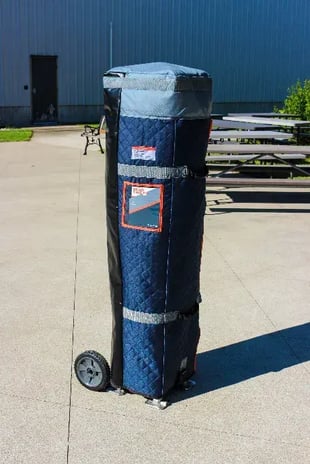
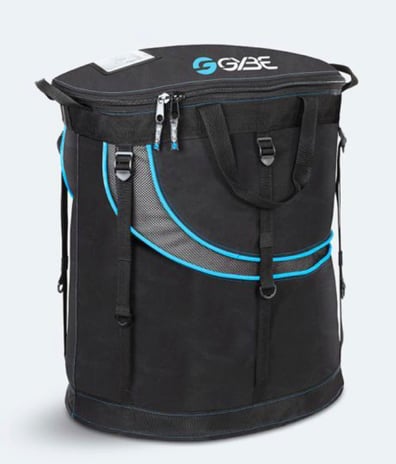
(*Pictured: Pop-up Tent Bag with Wheels & Inflatable Gybe Tent Backpack)
Brand Presence and Visual Differentiation
If your event footprint needs to look polished, both tent styles can get you there. A custom pop-up tent gives you a lot of room for brand visibility through the canopy, sidewalls, flags, counters, frame colors, and other accessories.
The difference is the silhouette. Pop-up tents are familiar, which can be a good thing when you need a clean, professional setup that works almost anywhere. Inflatable tents have a more distinctive shape, which can help your space stand apart when you’re lined up next to rows of standard canopy tents.
Recommended Reading: 9 10’x10’ Canopy Tent Design Ideas Built for Attention and Function
Size Range and Configuration Flexibility
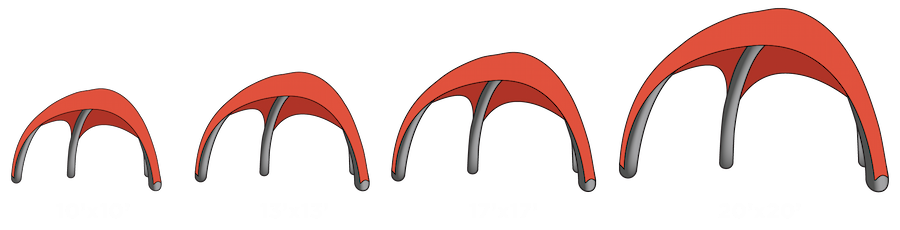
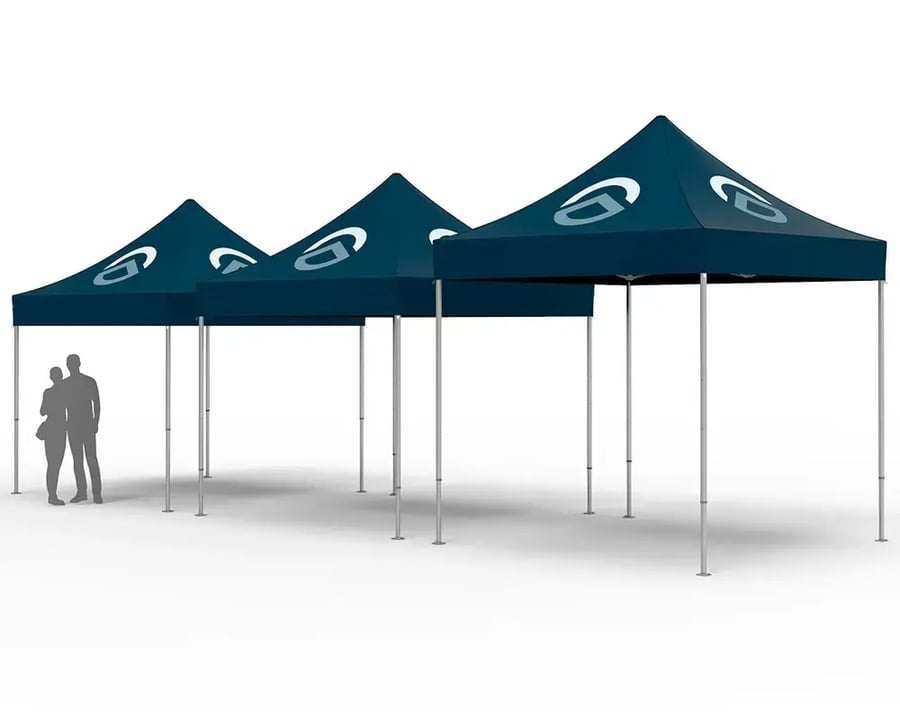
If you need the widest range of sizes, pop-up tents give you more room to dial in the exact footprint. You can choose from compact setups like 5x5 and 5x10, common event sizes like 10x10 and 10x20, or larger pop-up configurations like 13x26 and 10x30.
Inflatable tents have a more focused size range, with options like 10x10, 13x13, 17x17, and 20x20. That works well when one of those footprints matches your activation, but if your team needs more size variety or a more modular setup across different events, a pop-up tent will usually give you more flexibility.
Recommended Resource: Which Size Custom Canopy Tent Do You Need? Sizing Guide (+Helpful Charts)
Customization and Accessories
If your activation depends on add-ons, pop-up tents usually give you more ways to build out the full setup. You can customize the canopy, sidewalls, frame color, counters, flags, rails, lighting, weights, and other accessories to create a more complete branded space.
Inflatable tents can still create a polished, custom branded footprint, but they do not have the same traditional frame system to mount or attach certain accessories. If the tent itself is the main branded moment, an inflatable can make a strong impression. If you need a more modular kit with lots of attached elements, a pop-up tent may be the better fit.
Cost and Turnaround
If timing is one of your biggest constraints, pop-up tents usually give you more flexibility. At TentCraft, for example, most custom pop-up tents have an average turnaround time of 3 to 5 days, which makes them a strong fit when your team needs a branded event setup quickly.
Inflatable tents typically require more planning. On average, our inflatable tents have a turnaround time of about 2.5 to 3 weeks. They are often a larger investment than a pop-up tent, too, so they tend to make the most sense when your team has more lead time and wants the added value of a more distinctive branded structure.
To compare costs:
A 10’x10’ medium-duty custom pop-up tent costs ~$2,000
A 10’x10’ heavy-duty custom pop up tent costs ~$3,200
A 10’x10’ Inflatable GYBE Tent costs ~4499
Recommended Resource: How Much Are TentCraft’s Custom Canopy Tents & Event Structures? Our Cost Guide
How to Choose Between A Custom Pop-Up and an Inflatable Tent
Choose a custom pop-up tent activation if you:
- Need a branded setup quickly
- Want the widest range of size options
- Need more budget and frame-strength flexibility
- Plan to use sidewalls, counters, flags, rails, lighting, or other add-ons
- Want a familiar setup process for your team
- Need one tent style that can work across many different event types
Choose an inflatable tent activation if you:
- Want a tent shape that stands out from standard pop-up canopies
- Have enough lead time to account for a 2.5 to 3 week average turnaround
- Want fewer rigid frame components to transport and manage
- Are comfortable planning around a pump and inflation-based setup
- Need a setup that can be handled by one person
- Do not need a large ecosystem of frame-mounted accessories
Still Need Help Deciding Between a Pop-Up Tent and an Inflatable Tent?
If you are still weighing the two options, the next step is to think through how your team will actually use the tent.
How often will it travel? How many people usually handle setup? How much space do you need? Do you need a full accessory kit, or is the tent itself the main branded moment? And how quickly do you need it in hand?
That is where our team can help.
At TentCraft, we work with event teams to match the structure to the use case, not just the product category. Whether a pop-up tent, an inflatable tent, or a different branded event structure makes the most sense, we can help you compare your options and build a setup that fits the way your team shows up in the field.
Contact us via our quick form or call (800) 950-4553 to talk through your next event setup.