
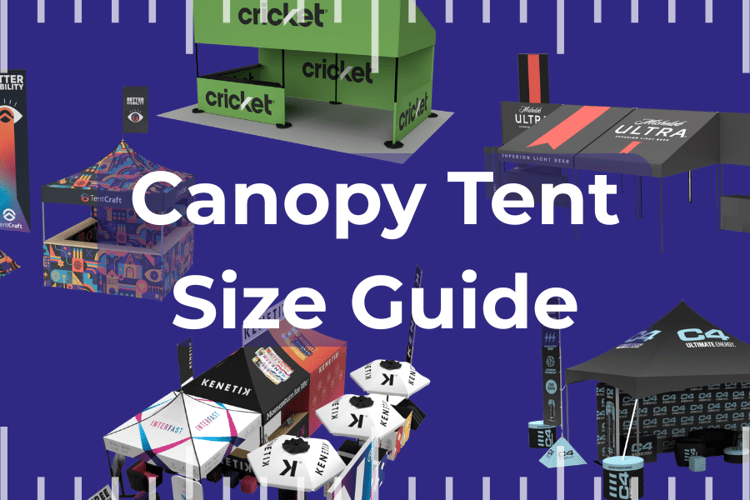
Key Takeaways:
Tent size influences how your team performs and how your brand is perceived.
Headcount alone isn’t enough. Movement, storage, seating, and traffic flow change your tent size needs quickly.
Equipment and inventory take up more room than most teams expect.
If guests are stepping under your canopy, layout and flow matter just as much as square footage.
Explore the use case and size charts below to get a better estimate of what tent size will fit your needs.
Canopy tent sizing is about what actually supports your event goals.
The size impacts how your team operates, how your brand shows up, and how comfortably guests engage with you throughout the event.
It creates flow. It protects organizations. It gives your team room to work confidently.
The wrong size risks introducing friction, impatience, awkwardness, and visual discomfort (too much or too little space).
And yes, square footage matters, but so does peak headcount, activation details, seating, equipment, storage, transport logistics, branding surface area, future growth, and even local event regulations.
This guide walks through those factors and more so you can confidently choose an event tent size that matches your activation needs.
Table of Contents:
How to Choose the Right Size Canopy Tent
As with all things, choosing the right tent size starts with asking the right questions.
Before you look at square footage charts or compare dimensions, take a step back and think through how you actually plan to use the space. The best footprint isn’t always the most common one, it’s the one that supports your team, your layout, and your goals.
Start with a few practical considerations, and the right size usually becomes much clearer.
1. How Many People Will Be Under the Tent and What Will They Be Doing?
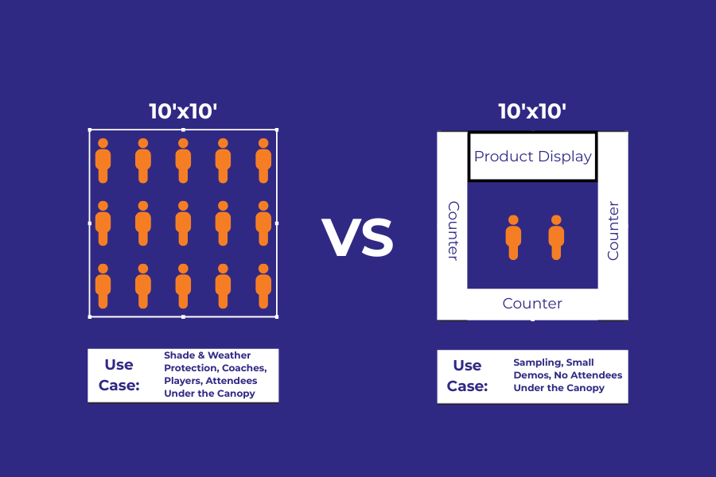
Standing shoulder to shoulder during a rain delay requires far less space than seated staff at a display table. A stationary staff of two needs a different footprint than a rotating group of athletes, coaches, and parents moving in and out all day.
Illustrative Example
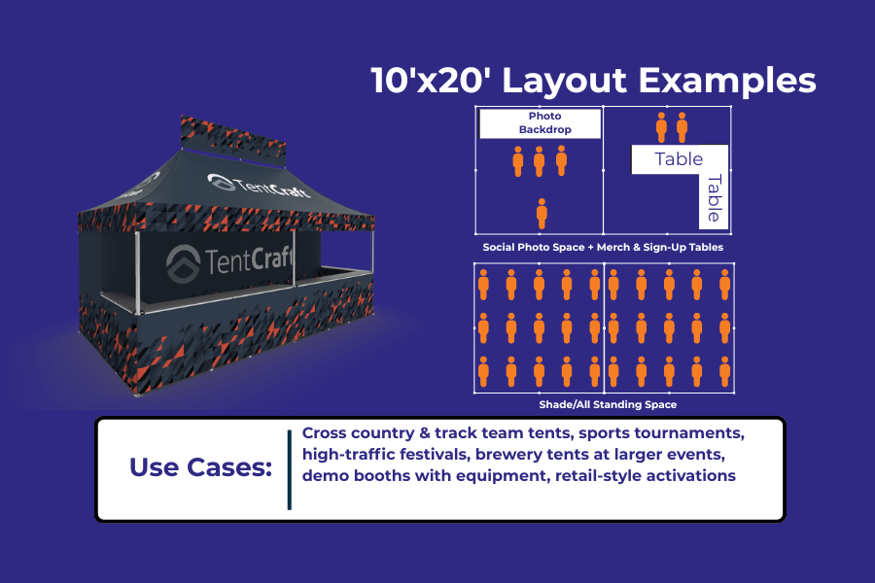
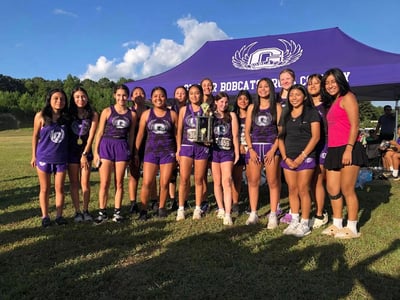
Take cross country or track meet tents, for example. For school sports teams, a 10’x20’ tent is one of the most popular choices because it allows teams to cycle athletes through while still giving coaches and parents room to gather out of the elements. The extra length creates breathing room in an easy-to-setup pop-up model, without becoming difficult or cumbersome to transport.
Now compare that to a product demo tent or festival bar setup. Even with just two staff members, you may need the same space with a 10’x20’ or 2 10’x10’s once you consider room for counters, coolers, inventory, point-of-sale systems, and for customers to approach comfortably.
When you think through both headcount and activation details, the right size usually becomes much clearer.
Here are some guidelines in a table format to consider where size, comfort, and a professional experience overlap:
|
Scenario |
People Count |
Activity Level |
Equipment / Inventory |
Recommended Size |
Why |
|
Solo vendor with one table |
1-2 staff |
Mostly stationary |
1-2 tables, light product display |
10x10 |
Compact and efficient for simple setups |
|
Small team with light engagement |
2-4 staff |
Moderate movement |
1–2 tables, small storage |
10x15 |
Extra length improves layout flexibility |
|
Sports team shelter |
25-30 rotating |
High rotation, standing |
Gear bags, coolers, chairs |
10x20 |
Handles traffic flow and rotation comfortably |
|
Demo booth or sampling station |
3-5 staff + guests |
Active movement |
Counters, coolers, POS, product |
10x20 |
People need space to move efficiently and to show off the product in use |
|
Festival bar setup |
3+ bartenders + line |
Active, continuous |
Bar tops, coolers, inventory |
10x20 |
Allows service + customer queue space |
|
High-traffic retail activation |
3-6 staff + browsing guests |
Continuous movement |
Multiple displays, racks, storage |
10x20 or 20x20 |
Separates selling, browsing, and storage zones |
|
Corporate hospitality or seating |
20-50 guests |
Seated or mingling |
Tables, chairs, décor |
20x20 |
Supports seating and structured layout |
|
Brand activation with zones |
30+ guests |
Multi-use areas |
Demo space, lounge, storage |
20x20+ |
Creates distinct engagement areas |
Recommended Reading: 10 Pro Tips for Designing Better Canopy Tent Activations
2. Will Event Attendees Be Under the Tent Canopy or Just Staff?
If your tent is strictly for staff, storing gear, managing check-ins, or providing shade between shifts you can select a size primarily around operational needs.
If event attendees will be stepping under your canopy, space needs increase quickly. You’ll want room for guests to browse, ask questions, and move naturally without feeling crowded.
Hosting people under your tent also means thinking about flow.
Where do they enter? Where do they pause? Where does your event team stand? A layout that feels intuitive makes your brand look polished and prepared.
When customers are part of the equation, giving yourself extra breathing room often pays off. A slightly larger footprint can make the difference between a setup that feels tight and one that feels welcoming.
3. What Are Your Storage and Inventory Needs?
Storage is one of the most overlooked factors when choosing a tent size.
Think about everything else that needs to live somewhere under your canopy’s square footage: products, gear bags, coolers, marketing materials, extra apparel, point-of-sale systems, or personal belongings from your team.
Then think about how you’ll maintain visual professionalism with all of those things needing a home.
If you need to protect items from weather and keep your setup looking polished, you’ll want enough room to organize intentionally. Clean sightlines and hidden storage make a big difference in how professional your activation feels.
It’s also worth deciding whether overflow storage will live under the tent, behind a tent wall, or in a nearby vehicle or other dedicated storage unit.
If everything needs to stay under the canopy, sizing up slightly can help keep your space looking sharp all day.
4. What Are You Specifically Going to Use the Tent For?
Here are a few scenarios of the common use types we see and what they often consider:
-
A retail setup typically needs space for browsing, product displays, and checkout. That often means room for racks, tables, and guests moving comfortably through the layout.
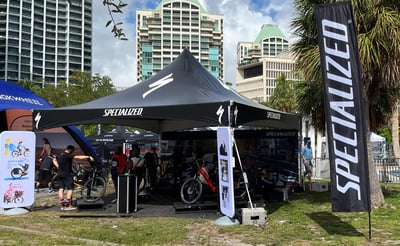
Also consider the size of the product you need to display. As one of the primary canopy tent providers for Sea Otter Classic, for example, a lot of our bicycle brands opt for 10’x20’ pop-up tents all the way up to multiple 20’x20’ E-series frame tents and event truss structures.
-
Sampling or demo booths require space for interaction. Counters, prep areas, coolers, and staff working side by side can quickly reduce usable square footage.
-
Team shelters prioritize coverage and flexibility. Athletes, coaches, and gear rotate in and out, so longer footprints like a 10’x20’ tend to handle that movement well.
-
Hospitality and registration setups need structure. Tables, signage, lines, and sometimes seating create a more defined layout that benefits from extra breathing room.
-
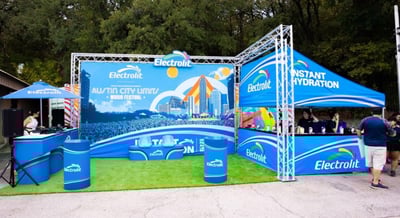
Experiential activations often combine several of these elements into one footprint. When your tent needs to support multiple zones that enable engagement, storage, conversation, and display, sizing up provides the flexibility to do it well.
5. What Is Your Tent Budget?
Budget will always play a real role in your final decision. Every event dream has reality constraints, and choosing the right tent means balancing goals with investment.
That said, it’s important to be honest about what your setup truly requires. Saving upfront can feel responsible, but if your tent limits engagement or needs to be replaced in a year, the short-term savings disappear quickly.
Most of our customers think in terms of investment and long-term value, not just price.
A good sales rep can help you evaluate options within your budget.
Ours navigate these conversations all the time to help agency teams and brands land on the best activation infrastructure for them. They can also help you communicate the long-term value of a larger footprint to leadership or stakeholders who may only see the initial price difference.
There are also creative ways to expand your usable space without overcommitting. Modular setups, phased purchases, or combining tent sizes strategically can provide flexibility while protecting your investment.
Recommended Reading: How Much Are TentCraft’s Custom Canopy Tents & Event Structures? Our Cost Guide
The Full Range of Available Tent Sizes + Specs
|
Tent Size |
Square Footage |
Frame Type Available |
|
25 sq ft |
||
|
50 sq ft |
||
|
64 sq ft |
||
|
100 sq ft |
Pop-Up (mightyTENT, MONARCHTENT), Frame Tent (E-Series, X-Series) |
|
|
150 sq ft |
||
|
200 sq ft |
||
|
10’x30’ |
300 sq ft |
|
|
169 sq ft |
||
|
195 sq ft |
||
|
286 sq ft |
||
|
338 sq ft |
||
|
390 sq ft |
||
|
225 sq ft |
||
|
400 sq ft |
||
|
600 sq ft |
||
|
800 sq ft |
||
Most Popular Custom Tent Sizes and Their Use Cases
10’x10’ Canopy Tents
|
Size |
Square Footage |
Standing Capacity* |
Seated Capacity* |
Popular Use Cases |
|
10’x10’ |
100 sq ft |
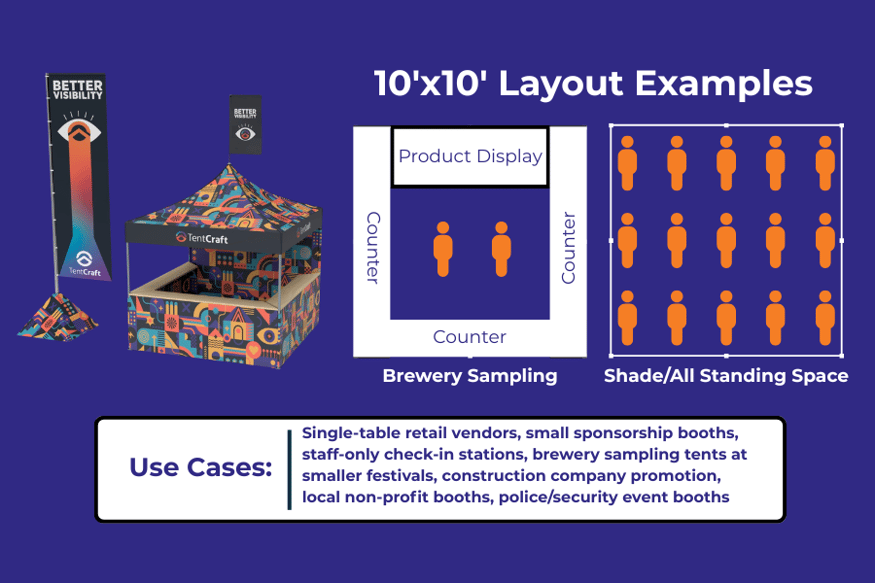
12-15 people |
8-12 people seated |
Single-table retail vendors, small sponsorship booths, staff-only check-in stations, brewery sampling tents at smaller festivals |
Recommended Reading: 9 10’x10’ Canopy Tent Design Ideas Built for Attention and Function
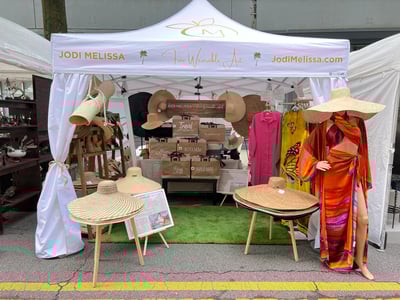
10’x10’ Customer Tent Examples
.jpg?width=400&height=400&name=10x10_california-power_square%20(1).jpg)
10’x15’ Canopy Tents
|
Size |
Square Footage |
Standing Capacity* |
Seated Capacity* |
Popular Use Cases |
|
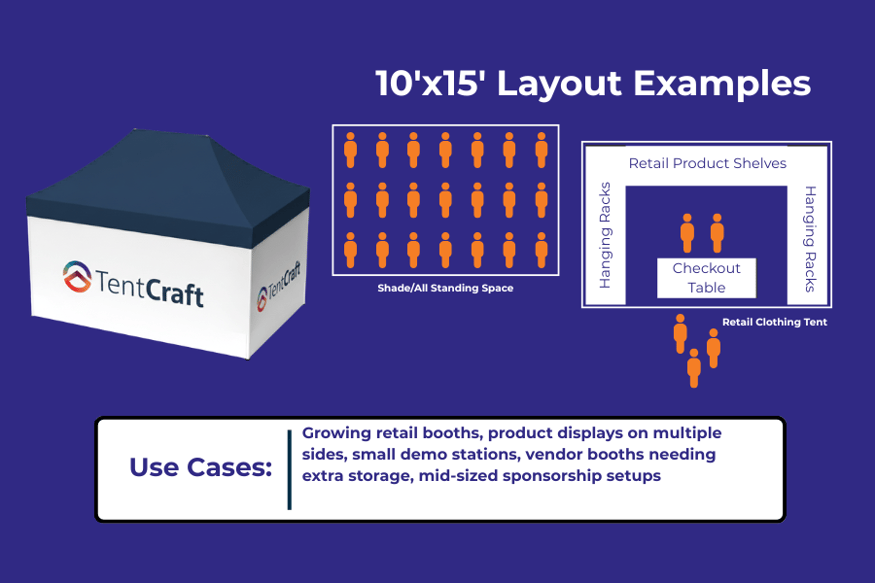
10’x15’ |
150 sq ft |
16-22 standing |
13-17 seated |
Growing retail booths, product displays on multiple sides, small demo stations, vendor booths needing extra storage, mid-sized sponsorship setups |
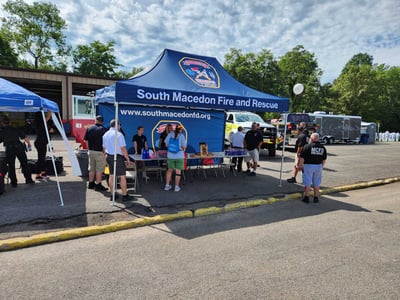
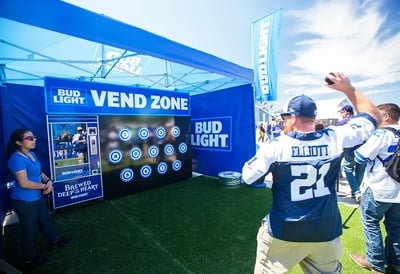
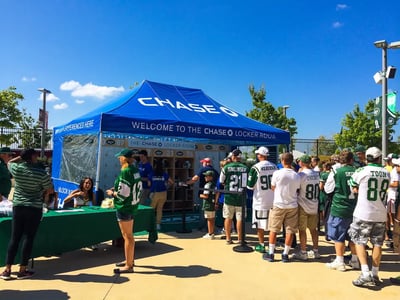
10’x15’ Customer Tent Examples
10’x20’ Canopy Tents
|
Size |
Square Footage |
Standing Capacity* |
Seated Capacity* |
Popular Use Cases |
|
10’x20’ |
200 sq ft |
23- 28 standing |
18-22 seated |
Cross country & track team tents, sports tournaments, high-traffic festivals, brewery tents at larger events, demo booths with equipment, retail-style activations |
Recommended Reading: 8 Custom 10x20 Canopy Tent Ideas for Your Next Event
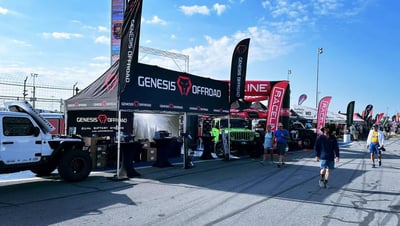
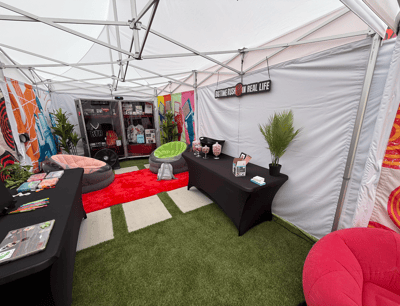
10’x20’ Customer Tent Examples
20’x20’ Frame Tents
|
Size |
Square Footage |
Standing Capacity* |
Seated Capacity* |
Popular Use Cases |
|
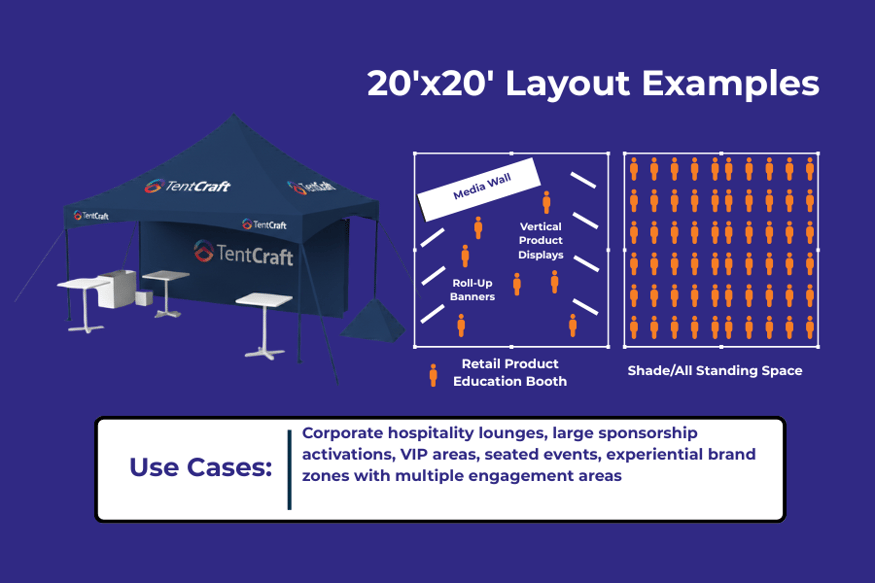
20’x20’ |
400 sq ft |
44-55 standing |
35-44 seated |
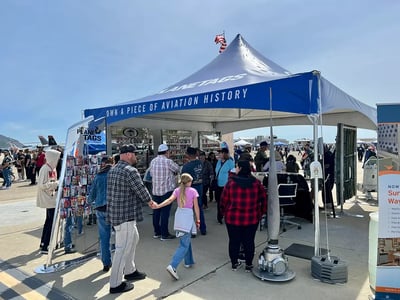
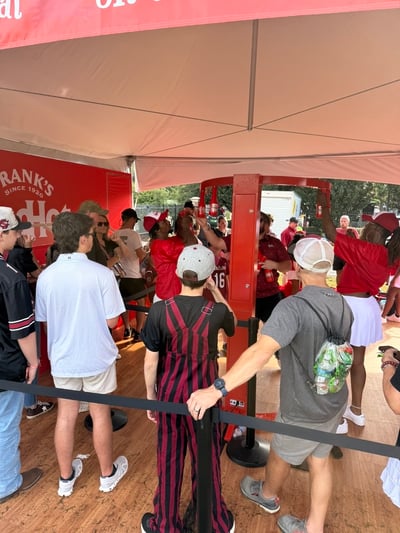
Corporate hospitality lounges, large sponsorship activations, VIP areas, seated events, experiential brand zones with multiple engagement areas |
20’x20’ Customer Tent Examples
10’x10’ vs 10’x20’ vs 20’x20’ Tent Comparison
|
Size |
Square Footage |
Key Advantages |
Best For |
Typical Users |
|
10’x10’ |
100 sq ft |
Compact, portable, quick setup, budget-friendly |
Simple layouts, lower traffic events |
Solo vendors, small concession tents, small retail booths, local sponsors, startups |
|
10’x20’ |
200 sq ft |
Double the space of 10’x10’, improved traffic flow, room for storage + engagement zones |
Rotating groups, steady foot traffic, multi-purpose layouts |
Cross country & track teams, sports tournaments, breweries, growing retail brands, Endurance sporting gear and athletic brands |
|
20’x20’ |
400 sq ft |
Strong visual presence, supports seating or multiple zones, ideal for immersive setups |
Hospitality, brand activations, high-capacity events |
Corporate sponsors, national brands, large product displays (cars, bikes) VIP lounges, experiential marketing teams |
Pop-Up Canopy Tents vs. Semi-Permanent Frame Tents: Size Comparison
As you’ve seen above, there are different frame types available for the range of tent sizes above. While dimensions may match on paper, pop-up and frame tents can feel very different in practice.
Here’s a quick comparison below, and you can explore the full breakdown in our dedicated pop-up tent vs. frame tent article.
|
Feature |
Pop-Up Canopy Tent |
Semi-Permanent Frame Tent |
|
Peak Height |
Typically lower peak |
Higher peak, more dramatic profile |
|
Usable Interior Feel |
Compact and efficient |
More open, spacious feel |
|
Weight |
Lighter, easier to transport |
Heavier-duty, more substantial components |
|
Setup Time |
Faster, often 1–2 people |
Longer setup, larger crew recommended |
|
Best Use Cases |
Frequent travel, sports teams, vendor booths |
Hospitality, long-term installs, large activations |
Signs You Might Be Outgrowing Your 10’x10’ Canopy Tent
The 10’x10’ is where many organizations start because it's small team friendly, easy to transport, is often most budget-friendly, and will suffice for a lot of small businesses who are getting with outdoor events.
Then as your brand and presence grows, your footprint will naturally need to expand with your foot traffic and demo needs.
Here are a few clear signs it might be time to expand:
-
Guests are gathering outside your tent - If people are stepping out of the canopy to browse or wait, space is likely tight and lines can turn off impatient prospects.
-
Your team feels cramped during peak traffic - When staff are navigating around each other to operate, efficiency suffers.
-
Storage is visible and cluttered - Boxes, coolers, and gear spilling into engagement space impact your brand presentation.
-
You’ve added products or displays - Growth in offerings often require more square footage to make sure they display well
Smart Ways to Expand Your Square Footage Without Buying “Too Much Tent”
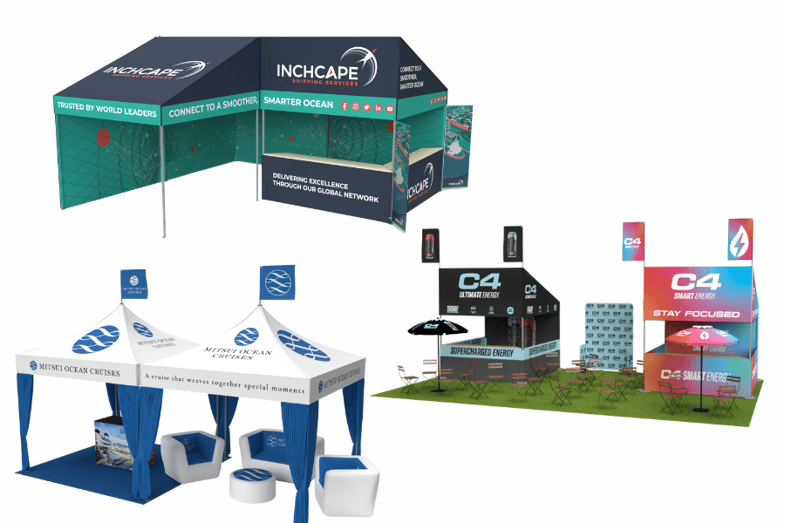
We recommend building flexibility into your activation setup.
A modular approach can work well for growing teams. For example, purchasing a 10’x10’ and a 10’x20’ instead of a single 10’x30’ gives you options. You can combine them for larger activations or deploy them separately to cover two events in the same week.
That versatility increases your reach without locking you into one large, fixed footprint. It also makes transport and storage more manageable in some cases.
There’s another practical consideration. Some municipalities or venues require engineering documentation or special permits once a structure exceeds a certain square footage threshold. That often means more added expenses.
In those cases, connecting multiple smaller tents can sometimes help you stay within event guidelines while still achieving the space you need.
If your event calendar varies throughout the year, a modular setup often delivers more long-term value than a single oversized structure.
FAQs: Canopy Tent Size Questions
What Is the Most Popular Canopy Tent Size?
The 10’x10’ is the most commonly purchased canopy tent size. It’s widely used, easy to transport, and works well for simple vendor setups and most SMBs attending local events.
How Many People Fit Under a 10’x10’ Tent?
A 10’x10’ tent provides 100 square feet of space. Most people recommend 5 to 6 square feet for standing capacity and 7 to 9 square feet for seated guests. Using these calculations you’d get:
You can typically fit:
-
12-15 people standing
-
8-12 people seated
Like you saw above, it depends on your specific use case details. Be sure to talk to a representative for recommendations for your specific activation or event.
Capacity decreases once you add tables, coolers, or display fixtures.
Is a 10’x10’ Tent Big Enough for a Trade Show?
It can be, depending on your layout.
If you’re running a simple booth with one table and light product display, a 10’x10’ may work well. If you plan to demo products, store inventory, or host steady traffic, a 10’x15’ or 10’x20’ often provides better flow and flexibility.
It also depends if you’re referring to an indoor or outdoor show. Indoor shows obviously take away the need for shade, but sometimes a flatroof tent or truss structure looks nice over all or part of your booth’s footprint.
How Much Bigger Is a 10’x20’ Than a 10’x10’?
A 10’x20’ tent has 200 square feet of space. That’s double the square footage of a 10’x10’.
The extra length creates room for storage, engagement zones, and improved traffic flow. This is why many teams upgrade once they grow.
What Size Tent Do I Need for 50 People?
For 50 standing guests, a 20’x20’ tent (400 square feet) is typically appropriate.
If seating is involved, you may need additional square footage depending on table layout and spacing requirements.
Do I Need a Permit for a 20’x20’ Tent?
Permit requirements vary by municipality and event organizer.
Larger tents, including 20’x20’ frame tents, may require engineering documentation or specific anchoring standards. Always confirm requirements with your venue or local authority before your event.
Can You Connect Multiple Canopy Tents Together?
Yes, many canopy tents can be connected to create larger footprints.
This approach offers flexibility. You can combine tents for bigger events or deploy them separately when needed, making modular setups a practical option for growing teams.
Want Help Choosing Which Size Tent or Tents You Should Go With?
If you’re still weighing your options, you don’t have to figure it out alone.
Our team works with brands, sports programs, and event organizers every day. We’re happy to talk through your goals, your event type, and your budget to help you land on a footprint that truly fits.
Give us a call (800) 950-4553) and we’ll walk through it with you. Prefer email? Fill out our contact form and we’ll get back to you shortly with thoughtful recommendations.